

Most “AI for your documents” products ask you to accept one thing quietly: your files get copied to somebody else’s inference endpoint. For a lot of workloads that is fine. For the ones we host, it is the whole argument. Unreleased masters, case files, patient records, controlled unclassified information, deal documents. Material whose value depends on not being disclosed, and which you cannot un-disclose once a third-party model has seen it.
Open Edge Cloud now runs OpenCloud and Synaplan together as a single tenant boundary. Your file platform and the AI layer over it live in your own deployment, on your own infrastructure, under your own identity provider. The files do not leave.
What this actually is
Two open-source products, each running as its own isolated single-tenant stack on our hardened platform, wired together properly.
OpenCloud is the file platform: spaces, sharing, expiring links, quotas, desktop and mobile sync, a full audit trail. We have offered it as a managed application for some time, on a STIG-hardened foundation with FIPS 140-3 validated cryptography.
Synaplan is an Apache-2.0 AI platform from metadist GmbH: a chat interface over your own corpus, retrieval-augmented search, document extraction with OCR, audio transcription, and per-interaction audit logging. It is genuinely open source with no open-core split. The self-hosted build is the same software as their cloud, with no features held back.
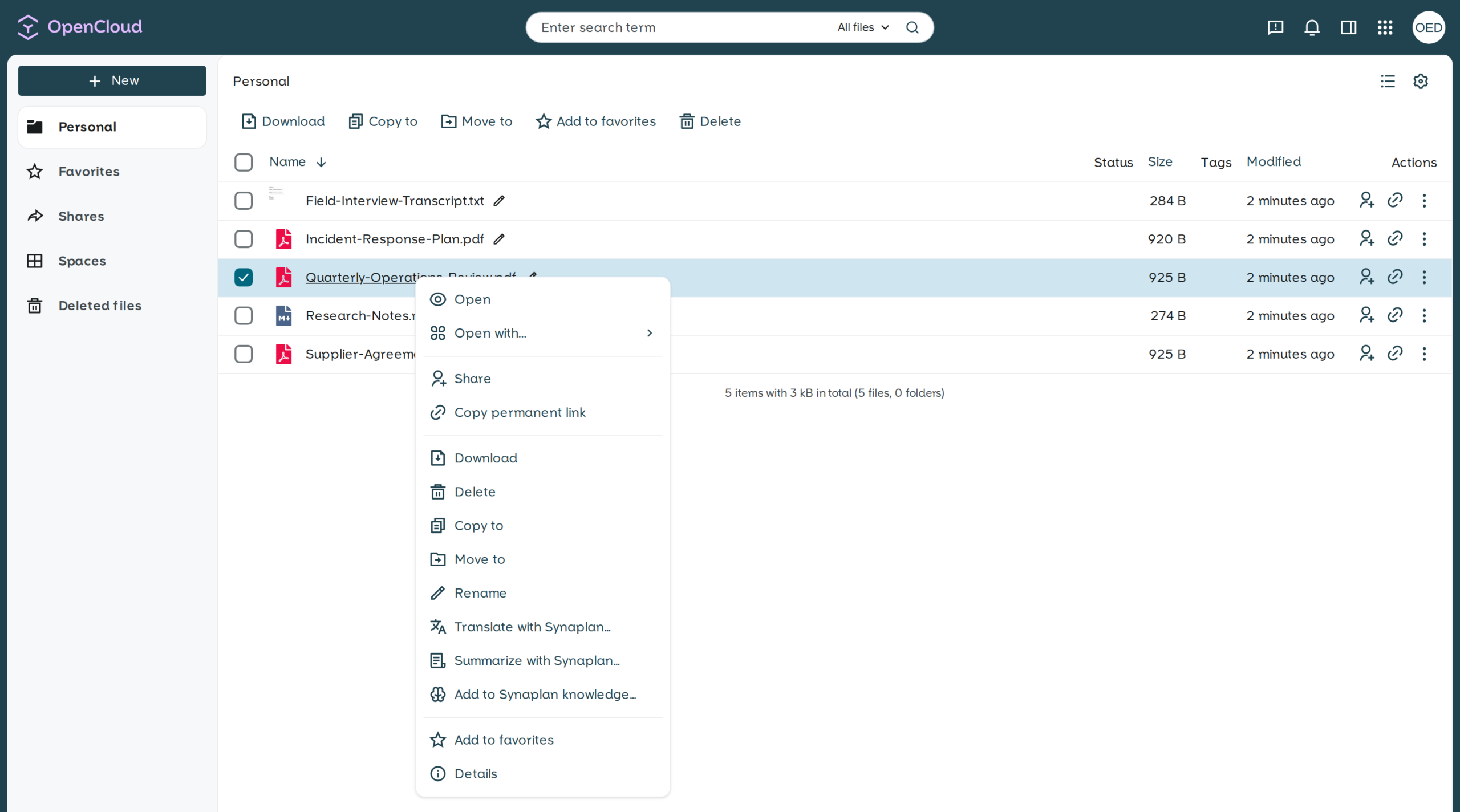
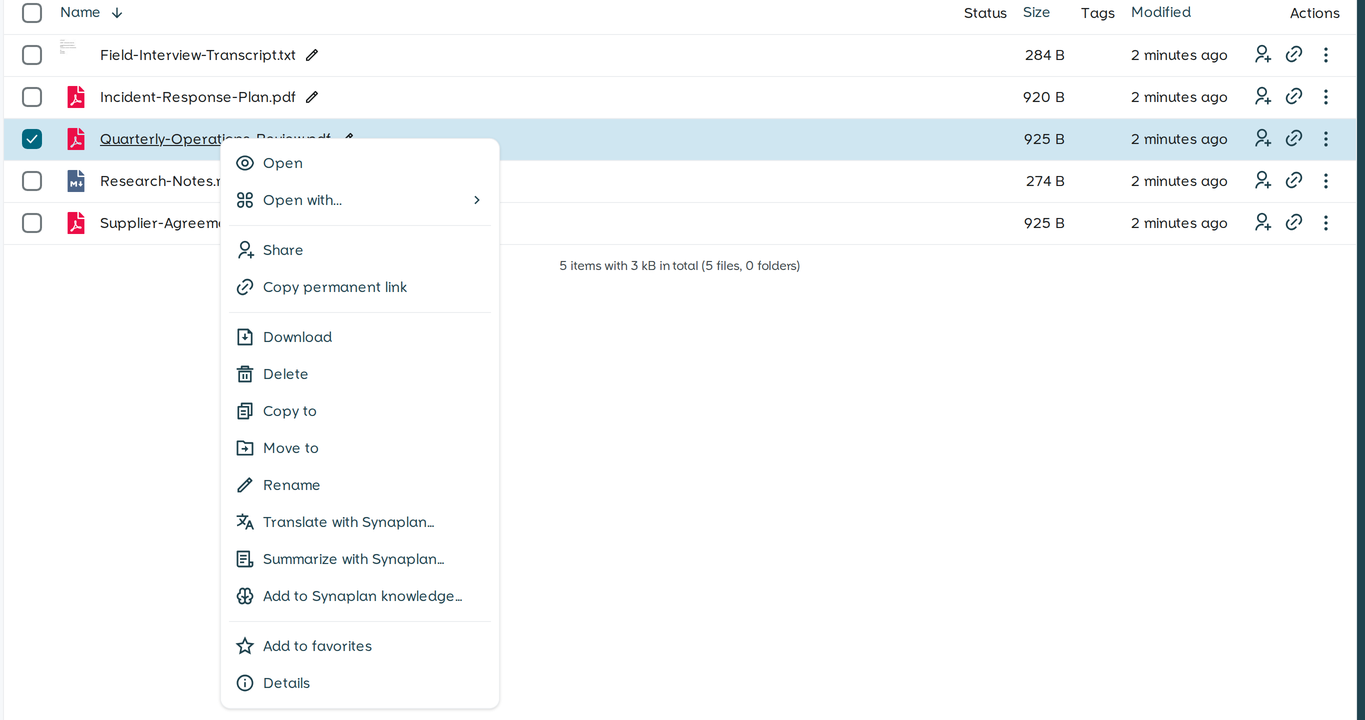
The integration puts three actions directly into the OpenCloud web interface, on the file itself: translate, summarize, and add to knowledge base. That last one indexes the file for retrieval, so from then on you can ask questions across your corpus and get answers grounded in your own documents rather than in whatever a general model absorbed from the internet.
None of that is remarkable on its own. Every SaaS file platform has shipped something similar in the last eighteen months. What is different here is where it runs and who it runs as.
Every AI call carries the real user’s identity
This is the part that took the work, and it is the part that matters if anyone is ever going to audit you.
The naive way to connect two systems is a shared API key. The AI layer holds one credential, calls arrive as that credential, and every request in the log looks like the same user. You cannot answer “who asked the model about this file”, you cannot set per-user limits, and revoking one person’s access means rotating a secret that everything else depends on.
We did not build it that way. OpenCloud and Synaplan federate to the same identity realm, and each request performs a standards-based token exchange so the call into the AI layer carries the identity of the actual human who clicked the button. Per-user audit, per-user quotas, per-user revocation. Remove someone from your directory and their access to the AI layer goes with it, at the next login, without touching anything else.
Synaplan logs every interaction on its side too: user, model, token count, latency, outcome, exportable as JSON or CSV with a retention window you choose. Combined with OpenCloud’s own audit service, the question “what did this system do with our files, and for whom” has a real answer rather than a vendor assurance.
Optional: the model runs inside your tenant too
By default the AI layer routes to whichever model providers you choose, which may well include commercial ones. That is a legitimate choice and for plenty of content it is the right one.
But local inference is a first-class part of the stack, not a bolt-on. For customers who need it, the model runs in the customer’s own deployment, on their own instance, in their own project. Transcription, extraction and retrieval happen without a single API call crossing a residency boundary. There is no third-party AI vendor in the data path to write into a contract, no retention policy to take on faith, and no training-data question to argue about.
That matters more than it used to. The EU AI Act’s general-purpose model obligations have applied since August 2025 with enforcement from August 2026, including an obligation to respect machine-readable rights reservations. Rights holders have noticed. So have general counsels. A platform whose honest answer to “where does our audio go” is “nowhere” is in a materially different conversation than one explaining a subprocessor list.
The platform underneath
Both stacks inherit the platform, because on Open Edge the platform is the product.
Single tenancy, for real. Not a namespace in a shared cluster. Each customer gets their own instances, their own project boundary, their own storage, their own subdomain. Your file estate and your AI layer are not co-resident with anyone else’s.
A hardened, FIPS-validated foundation. Instances run on our own STIG-aligned hardened image with FIPS mode enforced, and TLS terminates against a FIPS 140-3 validated cryptographic module (CMVP certificate #5115). The services we build ourselves for this integration are hardened builds whose application-layer cryptography operates in FIPS 140-3 mode as well, not just the transport around them. The posture is verified automatically at the end of every deployment. If a check fails, the instance is not handed over.
One provisioning pipeline. The hardened VM, the storage, the DNS record, the certificates, the identity clients, the application configuration and the final verification all come out of the same automated path. A new environment is a same-day event, and it is reproducible rather than hand-assembled.
Operated, monitored, backed up. Patching, version upgrades, backups and monitoring are ours to run. Logs and metrics ship to our observability platform under your own tenant, isolated from every other customer’s telemetry.
Sovereign by default. US datacenters, operated by US persons. Open Edge follows SOC 2 and ISO 27001 control frameworks, is engineered to the FedRAMP Moderate baseline, and supports HIPAA-eligible workloads.
What it is not
Worth being direct, because overselling this is the fastest way to lose the people it is built for.
This is a sovereign, AI-capable secure file platform. It is not a preservation-grade digital asset management system. If your requirement list includes embedded metadata standards, rights and clearance ledgers, fixity programmes or per-recipient watermarking, those are not features of either product, and anyone who tells you otherwise has not read the documentation. Those are on our roadmap because customers have asked for them by name, and we would rather scope that work honestly with you up front than discover the gap after a contract is signed.
And on accuracy: open-weight models running locally are still behind the best hosted models at hard tasks, particularly degraded or noisy historical audio. The pipeline is sovereign today and gets better as open models do. Human review is assumed from day one, and AI-generated metadata should live as a separate, attributed, confidence-scored layer that never silently overwrites what a person asserted. That is how we would build it with you.
Who this is for
Organizations sitting on material they cannot afford to disclose, who want modern AI over it anyway:
- Media and music rights holders with unreleased or embargoed catalogues.
- Law and accounting firms whose client data has to stay in a known jurisdiction with a clean chain of custody.
- Healthcare and life-sciences teams that need HIPAA-eligible collaboration and cannot route content through an undisclosed subprocessor.
- Government contractors under DFARS and CMMC obligations, where FIPS-validated cryptography and a documented hardening baseline are table stakes.
- MSPs and resellers who want to offer an isolated, hardened, AI-capable file platform per client without operating the platform behind it.
If that describes you, the conversation starts with what you actually hold and what it would cost you to leak it. Talk to us, or read more about Managed OpenCloud.