
Update – March 21, 2026:
Since this article was published, the conflict has escalated into a full-scale war now in its 21st day. Iran has attacked energy infrastructure across all six Gulf states. Qatar’s Ras Laffan LNG complex sustained extensive damage. Saudi refineries in Riyadh were struck. Oil has surpassed $115 per barrel with 10 million barrels per day of Gulf production offline – the largest supply disruption in the history of the global oil market. The case for CONUS data residency outlined below is stronger now than when it was written.
Nine days ago, US and Israeli forces struck Iran. The Strait of Hormuz is closed. Energy markets are in chaos. And state-sponsored cyber operations against US infrastructure are not a future risk – they are happening now. For enterprises running regulated or sensitive workloads, the question of where your data physically resides and who can access it has moved from a compliance checkbox to an operational survival question.
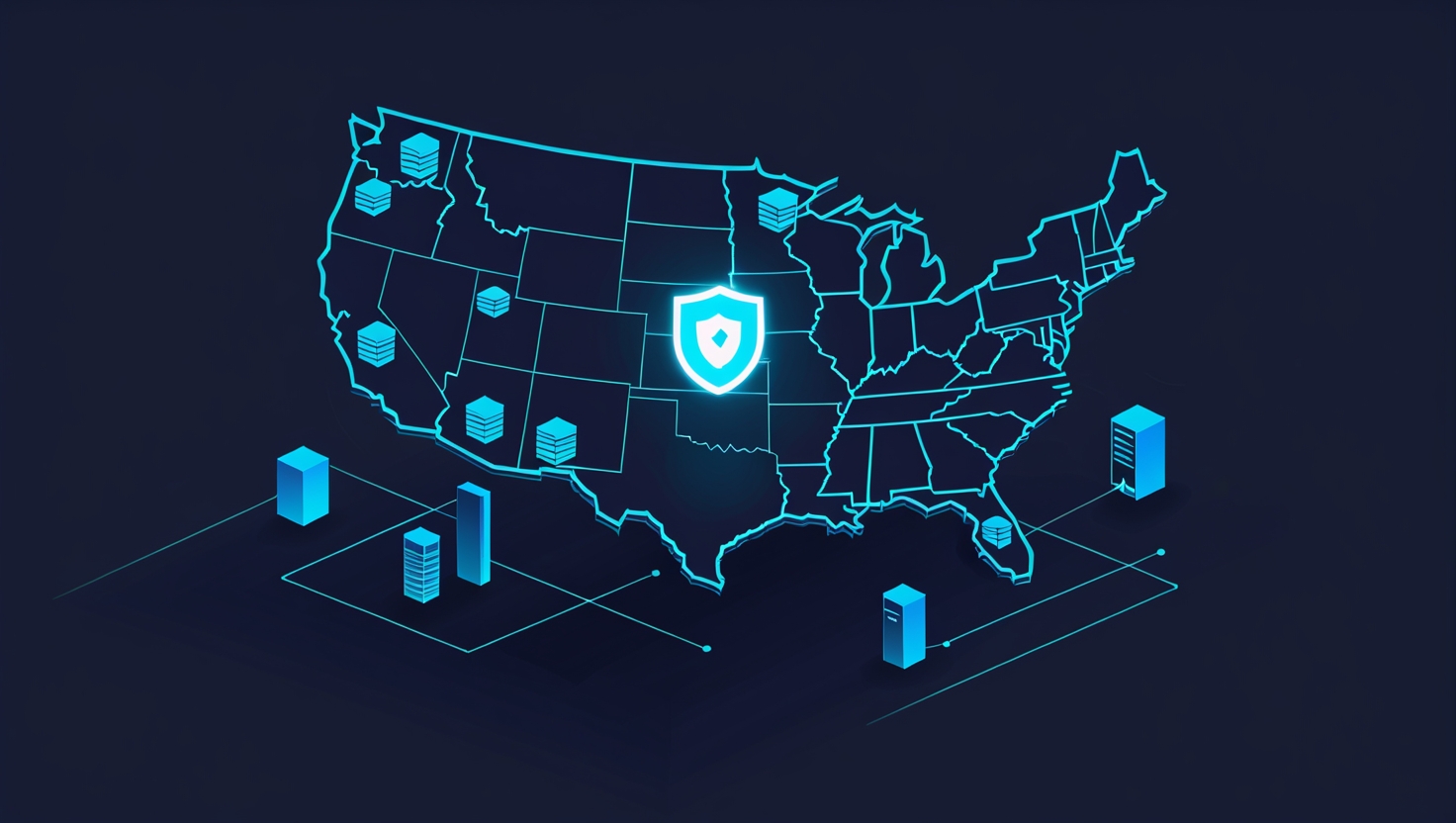
CONUS data residency – keeping your data, control planes, encryption keys, and operational personnel entirely within the Continental United States – is the foundation of that answer. Not “US region” on a hyperscaler. Not a flag in a console that says your VM launched in Virginia. Actual, verifiable, end-to-end US sovereignty over your infrastructure.
Here is why it matters more now than at any point in the last two decades, and what to look for when evaluating whether your cloud provider actually delivers it.
The Geopolitical Environment Has Changed
The February 28 strikes and Iran’s retaliation have produced a set of conditions that directly affect enterprise infrastructure decisions. These are not hypothetical scenarios. They are current operational realities.
Strait of Hormuz Closure
Twenty percent of the world’s oil supply transits the Strait of Hormuz. Its closure has triggered energy price spikes that are already affecting data center operating costs globally. Cloud providers with infrastructure in the Gulf states, Southeast Asia, and Europe are exposed to energy supply disruptions that do not affect CONUS-based facilities drawing from domestic US power grids.
Active Cyber Warfare
CISA, the FBI, and the NSA have issued joint advisories warning of Iranian cyber retaliation against US critical infrastructure. But the risk extends beyond Iranian actors. Periods of geopolitical instability embolden opportunistic attacks from other state and non-state actors who exploit the fog of conflict. If your cloud provider operates infrastructure in contested regions, those facilities and their interconnections become higher-value targets.
Submarine Cable Vulnerability
International submarine cables carry over 95% of intercontinental data traffic. They are physically vulnerable, concentrated at chokepoints, and increasingly targeted during geopolitical conflicts. The Red Sea cable disruptions in 2024 demonstrated how quickly regional instability can degrade connectivity to data centers outside CONUS. If your “US region” workload depends on a global control plane that routes management traffic through international links, a cable disruption thousands of miles away can affect your operations.
“US Region” Is Not US Sovereignty
This is the most important distinction that enterprises get wrong when evaluating cloud providers for data residency requirements.
AWS, Azure, and GCP all offer US regions. You can launch a VM in Northern Virginia and your compute and storage will physically reside in the United States. But that is only one layer of the problem. Data residency for the VM itself does not mean sovereignty over the entire stack.
Global Control Planes
Hyperscaler control planes – the systems that manage identity, access, orchestration, billing, and encryption key management – operate globally. Your VM may be in Virginia, but the IAM system authenticating access to it, the key management service encrypting its storage, and the logging pipeline capturing its audit trail may route through infrastructure in other countries. Metadata about your workload, access patterns, and operational state flows through systems you cannot inspect and jurisdictions you may not have evaluated.
Multinational Corporate Structures
AWS is a subsidiary of Amazon. Azure is a subsidiary of Microsoft. GCP is a subsidiary of Alphabet. All three are multinational corporations with operations, employees, and legal entities in dozens of countries. They are subject to foreign government data access requests through mechanisms like the EU’s GDPR Article 48, the UK’s Investigatory Powers Act, and similar frameworks in countries where they operate. The US CLOUD Act allows US law enforcement to compel data from US companies regardless of where the data is stored – but the reverse is also true. Foreign courts can and do attempt to compel multinational US companies to produce data.
A US-only company with no foreign subsidiaries, no foreign employees, and no foreign infrastructure is not subject to these foreign legal mechanisms. That is a structural difference, not a policy difference.
Offshore Support and Operations Teams
Cost optimization drives hyperscalers to maintain support, operations, and engineering teams in multiple countries. When you open a support ticket or a provider performs maintenance on your infrastructure, the personnel accessing your environment may be located outside the United States. For workloads subject to ITAR or EAR, this is not a policy preference – it is a legal requirement. ITAR-controlled technical data can only be accessed by US persons. If your cloud provider cannot guarantee that every person with access to your environment is a US person, you have an export control problem.
ITAR, EAR, and the US-Person Requirement
The International Traffic in Arms Regulations (ITAR) and Export Administration Regulations (EAR) impose strict controls on who can access certain categories of technical data and defense articles. The core requirement is simple: access must be limited to US persons.
A “US person” under ITAR means a US citizen, lawful permanent resident, or a protected individual. It does not mean “someone who works for a US company” or “someone who accesses data from a US IP address.” The distinction matters because violations carry severe penalties – criminal prosecution, debarment from government contracts, and fines up to $1 million per violation.
For enterprises in the defense industrial base, aerospace, or any sector handling controlled technical data, the cloud provider question is straightforward:
- Can you guarantee that all personnel with logical or physical access to my environment are US persons?
- Can you guarantee that no data, metadata, or encryption keys transit or replicate to infrastructure outside the United States?
- Can you guarantee that no foreign government has a legal mechanism to compel access to my data through your corporate structure?
If the answer to any of these is “no” or “it depends on configuration,” you do not have CONUS data residency. You have a US region with caveats.
What Actual CONUS Data Residency Looks Like
True CONUS data residency is not a feature you toggle in a dashboard. It is an architectural decision that affects every layer of the stack – from physical infrastructure to corporate governance. Here is what it requires.
Physical Infrastructure in the United States
All compute, storage, networking, and control plane infrastructure must be physically located within CONUS. Not “primarily” in the US. Not “with an option to restrict to the US.” All of it. Open Edge operates exclusively out of Iron Mountain VA-1 in Manassas, Virginia. Every server, every switch, every storage device, every encryption key – physically in the United States. There is no second region in Frankfurt, no disaster recovery site in Singapore, no edge node in London.
US-Based Personnel Only
Every person with access to customer environments – engineering, operations, support – must be US-based. Open Edge has no offshore teams, no foreign contractors, and no multinational staffing arrangements. When you contact support or we perform maintenance on your infrastructure, the person on the other end is in the United States.
No Foreign Data Replication
Data, metadata, logs, encryption keys, and backups stay within CONUS. There is no cross-border replication for redundancy, no global CDN caching layer that might place copies of your data in foreign jurisdictions, and no telemetry pipeline that sends operational data to analytics systems outside the United States.
No Multinational Parent Company
Open Edge Cloud is a US company with no foreign subsidiaries, no foreign investors with governance rights, and no corporate structure that creates legal exposure to foreign government data access requests. This is not a policy we adopted. It is how the company was built.
FIPS 140-3 Validated Encryption
All data at rest is encrypted using AES-256 with cryptographic modules that are FIPS 140-3 validated (CMVP Certificate #5115), running on Ubuntu 24.04 LTS with OpenSSL 3.x. All data in transit uses TLS 1.2 or higher. Encryption keys are generated, stored, and managed within the same US data center where your workloads run. There is no global key management service, no cross-region key replication, and no key escrow arrangement with any third party.
SOC 2 and ISO 27001 Control Frameworks
Open Edge follows SOC 2 and ISO 27001 control frameworks across its infrastructure and operations. Every API call is logged with user identity, source IP, timestamp, and action. Audit logs are searchable, exportable, and map directly to the evidence requirements these frameworks define. For enterprises that need to demonstrate data residency controls to their own auditors and regulators, this is the documentation layer that makes CONUS residency provable, not just claimed.
The Cost Argument for Sovereign Infrastructure
A common objection to US sovereign cloud is cost. The assumption is that single-region, US-only infrastructure must be more expensive than hyperscaler pricing. In practice, the opposite is often true for enterprise workloads.
Hyperscaler pricing models are designed for variable, consumption-based workloads. Enterprises running steady-state infrastructure – persistent VMs, predictable storage, consistent network throughput – pay a premium for flexibility they do not use. Add egress fees, cross-AZ transfer costs, premium support tiers, and the compliance tooling required to enforce data residency on a platform that was not designed for it, and the total cost of ownership frequently exceeds what a purpose-built sovereign cloud charges.
Open Edge uses contract-based pricing with no per-user SaaS fees. You pay for the infrastructure you commit to, not for the number of people who access it. Security features, audit logging, RBAC, MFA enforcement, and firewall management tools are included in the platform – not gated behind premium tiers.
The Window for Reactive Decisions Is Closing
The current geopolitical environment is not temporary. Even when the immediate crisis de-escalates, the structural conditions that make CONUS data residency important – great power competition, state-sponsored cyber operations, submarine cable vulnerability, foreign government data access laws – are permanent features of the operating environment. They are intensifying, not receding.
Organizations that treat data residency as a compliance checkbox will continue to discover, during each successive crisis, that their “US region” deployment does not actually deliver what they assumed it did. Organizations that build on infrastructure designed for US sovereignty from the ground up will not have that problem.
The best time to move your regulated workloads to genuinely sovereign US infrastructure was before the current crisis. The second best time is now.
Talk to Us
Open Edge Cloud is purpose-built for enterprises that require genuine CONUS data residency – not a region selector on a global platform. If your organization handles ITAR-controlled data, operates in the defense industrial base, or simply needs to know that your infrastructure, your keys, and your data never leave the United States, we should talk.